"the thing that i loved the most about the idea of pirate radio was that it felt mysterious, free, and authentic. everything i hoped i might grow up to be in my adult life. how hard could it be? why couldn’t my voice be the thing people stumbled across and found comfort in in the middle of the night?"
- nic silver, tanis podcast
Pirate radio stations are stations that broadcast without a valid license. Reasons for creating a pirate station range from music to activism to simply the pure thrill of it. Pirate radio is often a story about people wanting to be heard when existing media wouldn’t give them airtime.
No page on pirate radio would be complete without mentioning the 1990 movie that had an impact on a generation, “Pump Up The Volume.” In the movie, the main character runs a pirate radio station where he speaks up about the injustices happening locally in his area as well as in society in general. The 1990s and 2000s saw a massive boom in pirate radio stations globally, and I’m sure that movie alone influenced some of these stations. (fantastic movie by the way)
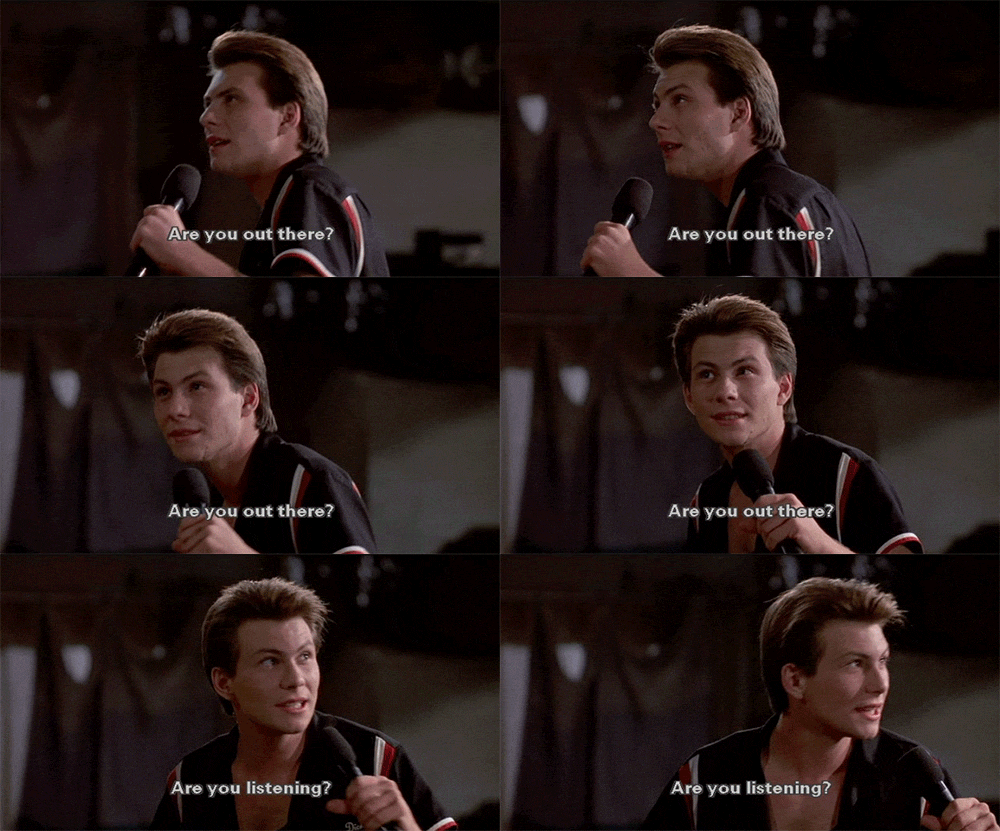
So you want to know the history of pirate radio?
Radio piracy started as soon as the airwaves began being regulated. These regulations varied by country. In the US, the 1912 "Act to Regulate Radio Communication" assigned amateurs and experimenters their own frequency spectrum and introduced licensing and call-signs. The Federal Radio Commission, was formed in 1927 and succeeded in 1934 by the Federal Communications Commission (the FCC), which enforces rules on call-signs, assigned frequencies, licensing, and acceptable content for broadcast.
There was a time in the early 1900s when radio was illegal in the United States.
“The Radio Act of 1912” gave the president legal permission to shut down radio stations in time of war. During the first two and a half years of World War I, before US entry, President Woodrow Wilson tasked the US Navy with monitoring US radio stations to "ensure neutrality." The US was divided into two civilian radio districts with corresponding call-signs, beginning with "K" in the west and "W" in the east. (This is still the case, so, for example, KWLP is a radio station from Arizona, and WRIR is a station from Virginia.) The Navy was assigned call-signs beginning with "N".
Following the US entry into World War I on April 6, 1917, President Wilson ordered all privately owned amateur and commercial radio stations to either shut down or be seized by the U.S. government. Control over all wireless communications was then delegated directly to the U.S. Navy. The Navy took over control of the airwaves, heavily censoring communications and shutting down amateur radio activity, particularly in the western United States. For the duration of WWI, it was against the law for private citizens to even own an operational radio transmitter or receiver, so amateur transmitting and receiving stations had to be disassembled. Also, prominent publications like the American Radio Relay League suspended operations entirely.
The Navy actually wanted to maintain a permanent government monopoly over radio after the war, but Congress rejected this. The ban on radio was lifted in the US in November 1919.
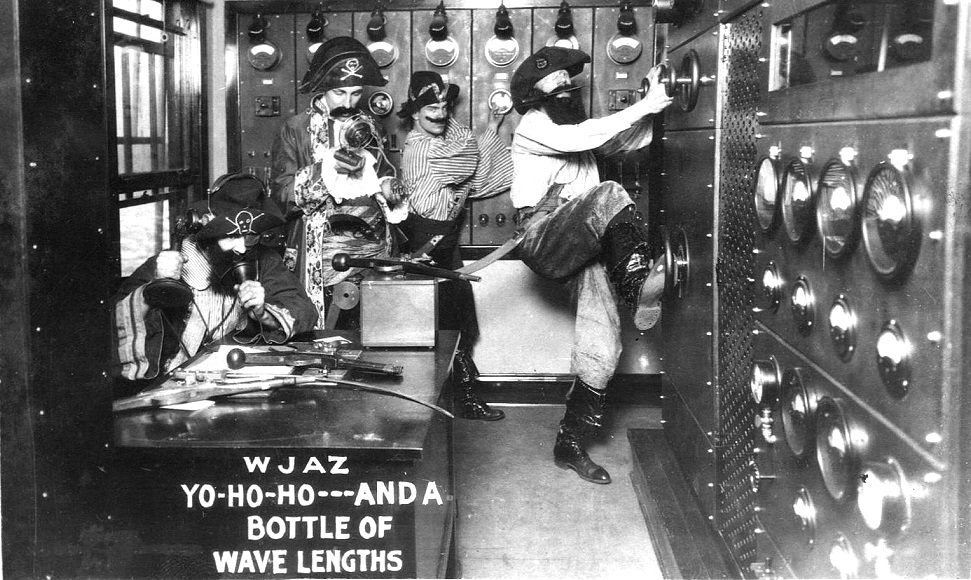
In 1926, Chicago's WJAZ challenged U.S. broadcast regulations by intentionally transmitting on Canadian-designated frequencies. This led to federal accusations of "wave piracy". On February 5, 1926, while litigation with the U.S. government was ongoing, the station broadcast the operetta "The Pirate," and the station owner orchestrated a famous publicity stunt, featuring engineers and DJs posing in full pirate regalia to protest and mock the government's frequency restrictions. The photo was published in the May 1, 1926 issue of Popular Radio magazine.
Even through all this, pirate radio didn’t see its first boom until the 60s.
Offshore pirate radio stations in international waters
So as I mentioned earlier, radio regulations vary by country. Which means these regulations don’t apply to international waters. This is the loophole pirate broadcasters started using in the 60s. (There was actually an earlier pirate radio ship in the 1930s off the coast of California, but it was shut down pretty quickly after starting.) The first of these floating pirate radio stations to start the movement in the 60s was Radio Veronica, located off the coast of The Netherlands, aboard the former Borkum Riff Lightship. The light tower was removed and a two-wire flat top antenna stretched between the masts about 66 feet high. The radio ship was anchored 3 miles offshore between Scheveningen and The Hague. Going on the air in April 1960, it broadcast the latest pop music to the Dutch people from a 10 kw transmitter on 1562 kHz. As the official broadcasters of Europe generally refused to broadcast modern music, pirate radio took off with great success. The very famous Radio Caroline, another pirate radio ship, followed in 1964 and it was so popular that many people falsely believe it was the first.
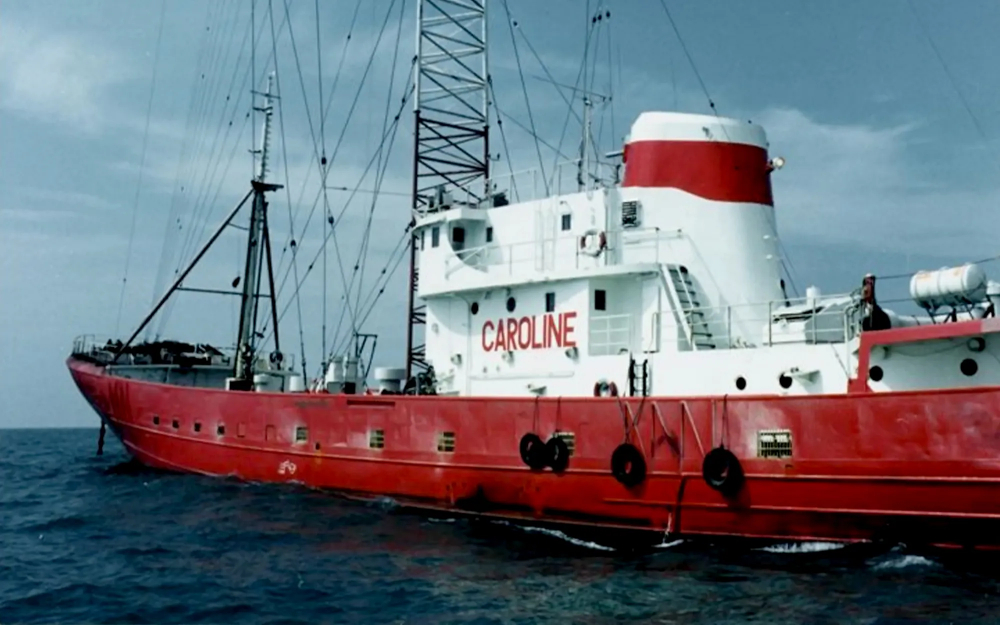
In the 60s, the BBC had a near monopoly on radio broadcasting in the UK. They refused to play rock or pop music except for a small time slot once a week. Their main programs consisted of news, children’s entertainment, and more traditional music such as light orchestra music, jazz, and show tunes. The BBC also didn’t allow commercials, making it hard for businesses to advertise to broader audiences. The public’s desire for better programs and ad space was obvious to 23-year-old Ronan O’Rahilly, the father of Radio Caroline.
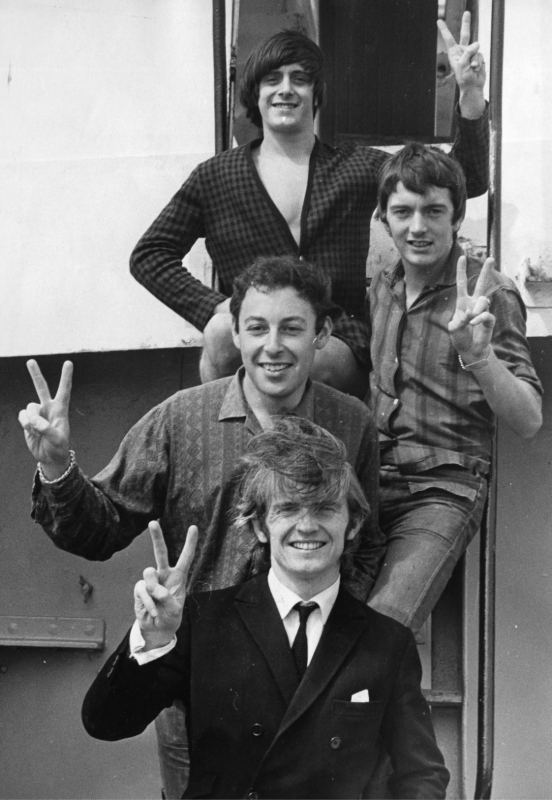
Radio Caroline anchored their ship off the coast of England and started broadcasting on Easter Sunday, March 28, 1964, introducing the world to Radio Caroline with a song by The Rolling Stones. Tenders (small supply boats) would bring food and other supplies to the ship and would also transport people to and from the ship. There were many offshore pirate radio stations at this time and the public loved them and treated them like celebrities every time they came ashore. The government, however, absolutely did not, but they didn’t want to lose public approval. So the government waited for someone involved with one of these stations to do something horrible enough that they would be branded a criminal, turning the public against them and allowing the government to step in and take legal action. On June 21, 1966, the government got their opportunity with a man named Oliver Smedley.
Oliver Smedley originally helped form another British pirate station called Radio Atlanta, but eventually merged with the Caroline Organization and changed its name to Radio Caroline South. When Reginald Calvert founded the rival pirate station Radio City, Smedley tried to persuade Calvert to merge with Radio Caroline in exchange for a new transmitter. The transmitter turned out to be antiquated and did not work properly, (one of its sections had been accidentally dropped into the sea prior to being installed, although it is uncertain as to whether this was responsible for its malfunctioning) and Calvert refused to pay for it. Smedley in response hired a group of riggers to board Radio City and retrieve the transmitter. The next day, June 21, 1966, Smedley received threatening phone calls from Calvert and that night Calvert went to Smedley's house in Essex. Smedley killed Calvert with a shotgun in what has been described as a "violent row". At his trial, Smedley said he feared Calvert was there to kill him. On 18 October 1966, the jury found Smedley not guilty of manslaughter in under a minute on the grounds of self-defence. But the government now had fuel to paint the radio pirates as criminals.
The UK passed the Marine Broadcasting Offences Act in 1967 which basically made it illegal for anyone subject to UK law to operate a pirate radio station. They also made tendering illegal, so even if the ships had non-British citizens they still would have no way of getting supplies or transport to and from the ships. The UK also expanded their legal jurisdiction to include sandbars that were home to abandoned WWII forts that were also being used as pirate stations. The radio pirates were not going down without a fight. While they had previously accepted the branding of “pirate radio,” they now wanted to be called “free radio.” They ran their Free Radio campaign through the spring and summer of 1967 and supporters wrote in to politicians stating their opposition to the Act. Despite their efforts, the Act went into effect at midnight, August 14, 1967. Stations started going silent. People thought bigger stations would find a way to stay on the air, but at 3PM on August 14, Radio London, another hugely popular pirate station, ended their transmission.
But Radio Caroline did not give up so easily. Ronan O’Rahilly, along with the few DJs that didn’t abandon ship, moved their operations off the coast of The Netherlands. However on March 3, 1968, their two ships were towed and impounded. The pirate radio boom had ended, but it had a lasting effect on the BBC. Just a month after the Marine Broadcasting Offences Act took effect, the BBC started their first pop radio station, Radio 1. They started broadcasting on September 30, 1967 and actually hired some of the popular pirate radio DJs. For example, Tony Blackburn, the DJ during the opening broadcast of Radio 1, had previously been a DJ for Radio Caroline and Radio London.
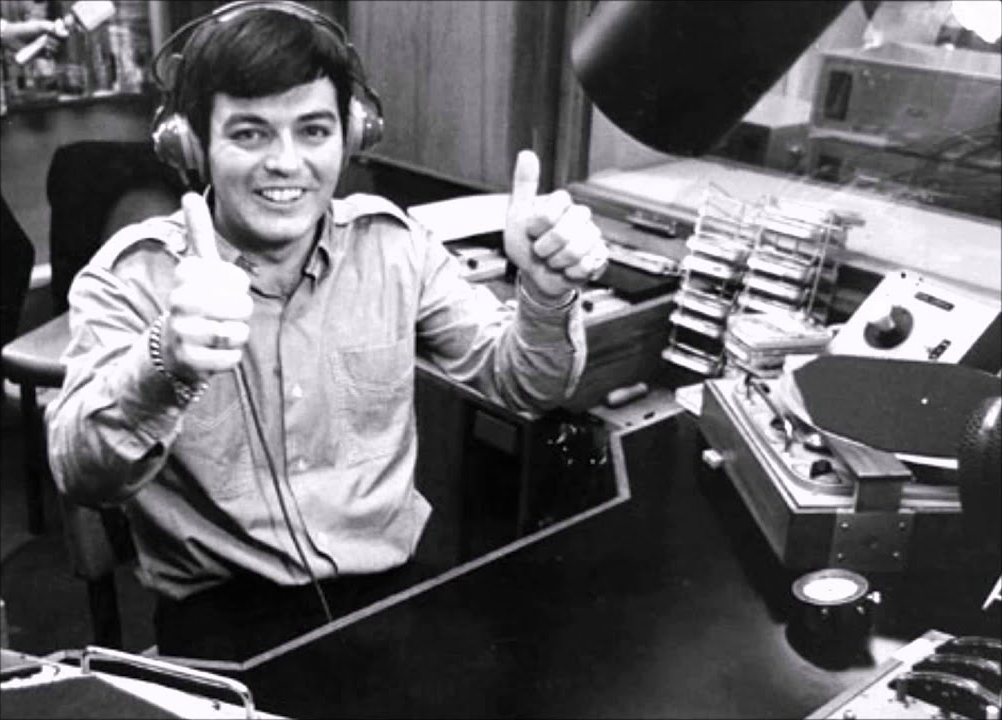
Enter stage left, the wonderfully chaotic Radio Northsea International
But it wasn’t over. In 1970, Swiss businessmen Edwin Bollier and Erwin Meister started the pirate radio station Radio Nordsee, more commonly known as Radio Northsea International (RNI). This was, in my opinion, the most chaotic station. Their ship was named Mebo II and was painted in bright, almost psychedelic colors. It carried a MW transmitter at 105 kilowatts (more than twice the 50 kilowatts used by Radio London and Radio Caroline), though it operated at 60 kW or less. It had the highest power of any ship-based pirate station, and the second-highest of any ship-based broadcast station. Mebo II also had SW and FM transmitters, able to simultaneously broadcast four different streams on four different channels. RNI first began broadcasts from the Dutch coast on January 23, 1970 in English and German.
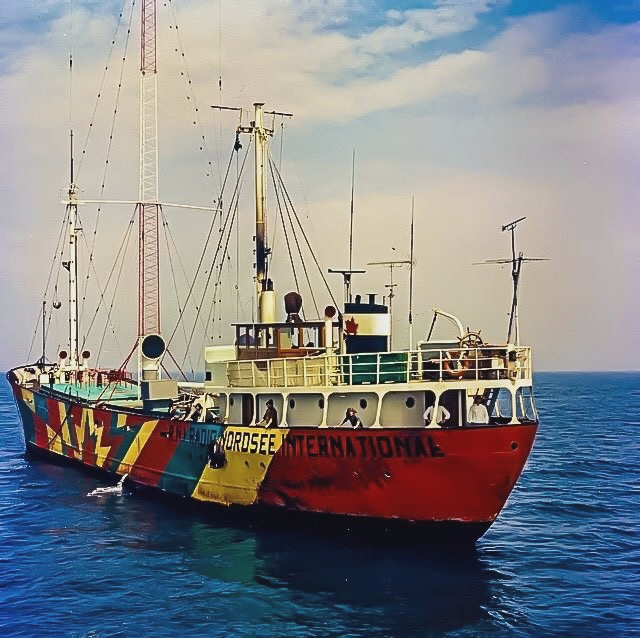
When regular broadcasting began on February 11, 1970 it was more popular in the United Kingdom than the Netherlands or Germany. So, in March 1970, Mebo II sailed to the East coast of England and anchored in international waters, five miles from the coast.
Then, on April 15, the Labour party of the British government deliberately jammed their signal.
This unintentionally gave them notoriety. Deliberate peacetime jamming by the UK government was unprecedented. It sparked public protests and became a pivotal political issue. So then Ronan O’Rahilly showed up. (Yes, this guy again. He’s back.) He told Bollier and Meister that if they rename their station “Caroline,” the public would sympathize with them more and maybe the government would stop jamming their signal. They agreed. And on June 13, 1970, five days before election day, RNI changed to Radio Caroline International and O’Rahilly launched a political campaign against the Labour party. Listeners were told that their freedom to listen to the radio station of their choice was under threat and that, if the Labour party were returned to power, the station would close. O'Rahilly headed the campaign on land, using a double-decker bus and posters depicting Harold Wilson as China's Chairman Mao.The campaign was so successful because a lot of the new, young voters at the time were once the teenagers who listened to Radio Caroline and other pirate stations. They believed the Conservative party would end jamming. They were successful in that the Labour party lost, but jamming continued.
Two days after the election, the station name reverted to RNI, and because jamming continued, Mebo II returned to the Dutch coast on July 23, 1970.
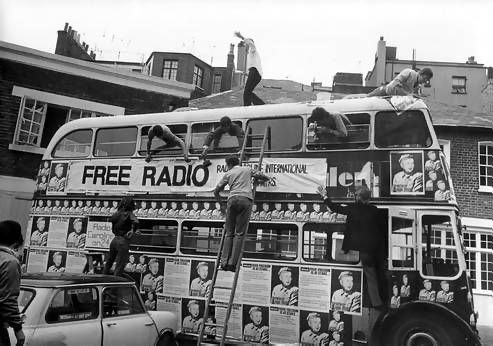
And then they almost got hijacked.
In August 1970, Kees Manders, who was involved with Radio Veronica, was invited to become the commercial director of RNI, but that invitation was later withdrawn. RNI’s managing director, Larry Tremaine, said nothing had been agreed upon. Then, on August 29, 1970, a salvage tug approached the RNI ship. Accompanying the tug was another boat, carrying Kees Manders. The DJs aboard RNI went on the air to report what was happening:
Andy Archer: “Seven minutes now away from two o'clock, and we have to apologise to you for interrupting our normal programme schedule with these urgent messages, but as you can probably appreciate, something rather drastic has happened. Or they're trying to make something happen which we won't stand for. We're refusing to allow anybody this radio ship, and if you've just joined us, perhaps you'd like to be put in the picture, that a tug has come alongside, along with a person by the name of Kees Manders, who apparently is a well known figure in Holland, and he is trying to take the ship away. Our Captain has only allowed him on board, and nobody else, and that will remain that way. We're not going to let anybody else on board the ship, only Mr Manders, to hear what he's got to say, but Radio Northsea International will stay broadcasting until we receive a definite order from our Head office in Zurich. So if anybody is listening in Zurich, or in London, or in our office in The Hague, in Scheveningen, perhaps they would like to do something, perhaps send a boat out, or perhaps try to make contact with us on the short-wave... Well, the situation is... none of us are sure what's happening at the moment but this certainly isn't an authorized tug... we have no tugs... the Mebo is in no need of a tug because we have perfectly good engines... The Captain allowed one of the men on board, but he refused to let any more on board, which is his prerogative... and this is the way it's going to stay until we receive details or instructions from our head office. So, once more we'd like to make a call to our head office in Zurich, or if anyone is listening in our London office, or in The Hague, perhaps you could try and get a message out to us on the short-wave link.”
Spangles Muldoon: “It seems they're gonna spray water onto the antenna, which apart from tripping out our transmitter, would give whoever did it a very lethal shock... So by all means, spray the aerial with water, if it makes you feel any better.”
Andy Archer: “...and the banging you can hear in the background is that we are taking all security precautions, and locking up the hatches to save anybody from coming down into the studio itself. So once more we must tell you that there's a raid taking place at the moment... an unauthorised raid, and we're doing our best to stop everybody coming on board, so all we ask for our friends on the shore... to send out help to us.”
While Archer and Muldoon continued to broadcast, others armed themselves with knives and petrol bombs to repel boarders. Switchboards in London, The Hague, and Zurich received calls from listeners. Erwin Meister arrived on a launch, followed by the Eurotrip tender and other craft. Eventually, Manders and the tug boat left. Later that day van Ness, a frigate of the Royal Dutch Navy, stood by. As the day ended, Larry Tremaine went on air with this statement:
“Ladies and gentlemen, I am very sorry for the inconvenience today that you have had, but unfortunately we have had problems out here. And, I'm glad the disk jockeys have done their part in keeping you informed, and that's what RNI plans to do... I'm out here right now with the owner of Radio Northsea International, from Mebo AG in Zurich, Switzerland and we hope we don't have too many problems. At the moment, the ships have pulled off. But we are sure, as they have told us, that they are coming back. They had brought a child, and a woman, on one of their ships, to kinda deter us from doing anything to them. Although it is our intention... [to defend ourselves]. As the owner of the station has said to the Captain of the trip that brought us out here, only the agent from the shipping company in Holland, myself, and the owner Mr Erwin Meister has come out to the Mebo. Many people wanted to come out to help us. We told them they could not come on our ship, we are not interested in any fights, we are not interested in any deaths at sea. This station is not around to make trouble, this station is around to provide you with musical entertainment. This is the reason that we asked that only the shipping agent, Mr Erwin Meister, and myself, Larry Tremaine, to come out here to the Mebo II to see what the problem was. We have contacted our attorneys, our solicitors in Holland, and we are trying to do our utmost to do the best for you. So please stay tuned. Thank you all very much for lighting up the switchboard at the Grand Hotel. We appreciate that very much. Also thank you very much for lighting up the switchboard in Zurich. As I understand, all the lines were flooded, showing your continued support for Radio Northsea International. We are not saying that at this time, that we do not still need help, because at this time they have pulled away. But we are sure that they are coming back. Mr Manders has no right to take this ship. There has never been a contract signed with him. There are no agreements between him and Radio Northsea International. This I can assure our listeners implicitly, there is no agreement, and there is no reason for this action whatsoever. We are very sorry for all this trouble, we are very sorry to interrupt music like this. But you can understand our involved situation out here. We will protect the Mebo II to the utmost. We will not leave this ship, we are prepared for them although we do not want a fight. We do not want any deaths, or anybody hurt at all. It went so far as to tell them, when they planned to put water on the transmitter, the disk jockeys, just by thinking of the people on the ship, and not thinking of themselves, told them not to put water on the transmitter, because it would kill everybody on the tug boat. This we did not have to do, but we did it because we are a music station. We are not around to injure or endanger any lives whatsoever. So please stay tuned, if you wish to help, we want it. But meanwhile, stay with us.”
About a month later, they shut down broadcasts.
RNI closed with less than 24 hours notice at midday on September 24, 1970, in exchange for one million Dutch guilders (about £100,000) from Radio Veronica. RNI agreed to close down after concerns that Veronica, which had been broadcasting for many years and very popular in The Netherlands, could be forced off air because of the recent problems. A final hour was hosted by Andy Archer, Alan West, and Steven Ladd. After that, the transmitters were silenced. Mebo II remained in international waters off Scheveningen in the Netherlands.
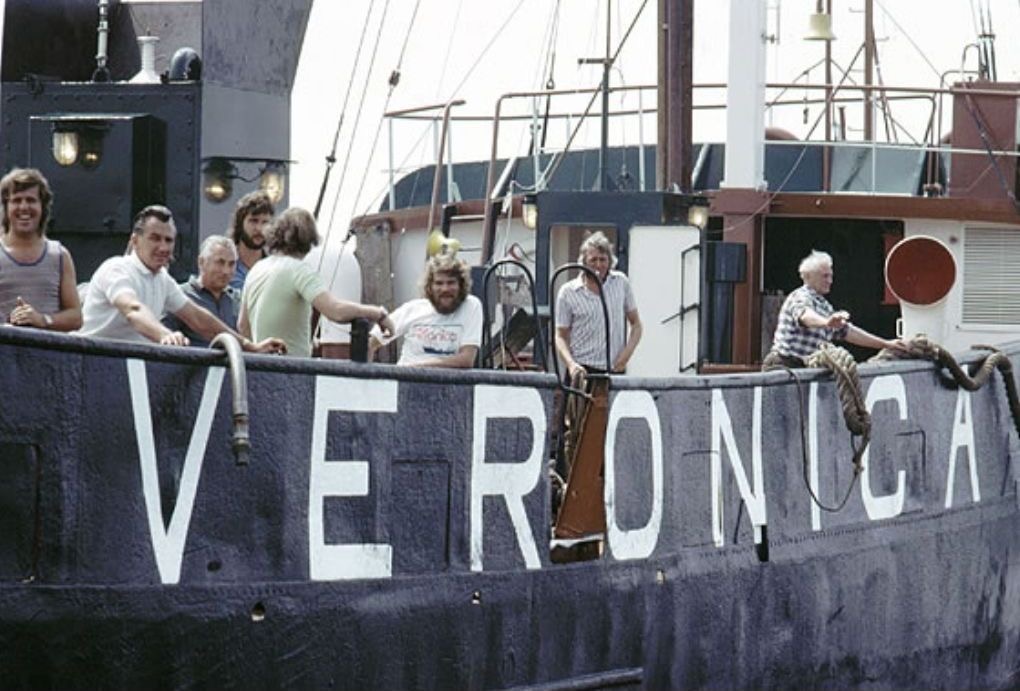
But they weren’t quiet for long
On Friday, January 29, 1971, Mebo II restarted broadcasts. The station identified itself on February 14, 1971:
“This is a test transmission from Radio Northsea International broadcasting on 220 meters medium wave band, that's 1367 kilocycles, and on Channel 44, that's 100 megacycles in the FM band, and short wave at 6205 kilocycles in the European band. We're very very pleased to have you around, may I cordially suggest that you might like to call up your friends on the telephone and let them know that Radio Northsea International is back, 220 on their dial.”
Then they got bombed.
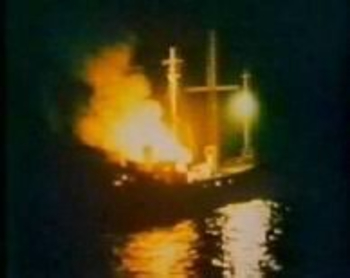
On Saturday, May 15, 1971, at 22:50, DJ Alan West interrupted his program to say there had been an explosion and that the ship was on fire:
“Mayday, mayday, mayday, this is Radio Northsea International from the Mebo II at exactly 52°11' latitude, 4°16' longitude, four miles from the coast of Scheveningen, Holland, one mile from the radio ship Norderney, Veronica. We are having to abandon ship very soon, the bridge and the engine room are on fire, the fire is taking control of the ship. The fire was caused by a bomb thrown on board from a small motor ship, repeat, small motor launch with an outboard motor. We don't know who it belongs to, but it certainly bombed us while it was here. This is the Mebo II on fire, we need help immediately. The Mebo II is now abandoning ship.”
At 23:40 the transmitters switched off and Mebo II was abandoned. The following morning, Mebo II restarted broadcasting. Repairs to the Mebo II were carried out at sea, allowing the station to continue without interruption.
On May 17, 1971, Norbert Jurgens, the advertising manager at Radio Veronica, was arrested and questioned by Dutch Police, and the following day Veronica director Bull Verweij was also held. Verweij appeared on Netherlands television to tell how he had paid a man 12,000 guilders (approximately £1,100) to force Mebo II into territorial waters. Once in the three-mile limit, the ship would have been liable to arrest or confiscation by creditors. In September 1971, all five suspects re-appeared in court, where it became clear how the plan had been developed and implemented. Also, according to the men, they had heard that RNI was involved with espionage for the eastern bloc, as there was an unproven rumor that that RNI’s shortwave equipment was sending coded messages to unfriendly countries. (There was never any evidence of this rumor being true.)
Although Meister and Bollier did not want to prosecute the offenders, all five were sentenced to one year in prison. The bombing of RNI convinced the Dutch government that it was time to outlaw the supply from the Dutch mainland of offshore radio stations on the high seas. The Dutch Marine Offences Act came into force on September 1, 1974.
RNI’s last transmission was on August 31, 1974.
And then, in 2008, they returned as an internet radio station you can listen to here.
Radio Caroline has also had an internet radio station since August, 2000. You can listen to them here.
The boom of pirate stations on land in the 90s and early 2000s
There was a massive global boom in pirate radio during the 1990s and 2000s. Driven by cheap, accessible FM transmitters and an anti-establishment DIY ethos, this era saw a surge of unlicensed, hyperlocal community and underground music stations. The movement took off on both sides of the Atlantic, defined largely by the specific cultural and legal climates of the era.
In the United Kingdom
In the UK, pirate radio activity was driven by the severe lack of music diversity and the lack of airtime for emerging underground music scenes on mainstream radio stations. At the beginning of the 1990s there were more than 500 illegal stations broadcasting in the UK. The government kept tracking down and shutting down stations, but more stations would constantly pop up. Pirate stations operated from residential tower blocks, warehouses, and rooftops, and utilized hidden transmitters and guerrilla engineering to evade government regulators. These stations were the heartbeat of the underground music scene and were fundamental in the popularization of genres such as acid house, jungle, grime, and dubstep.
One iconic station, Rinse FM, first started broadcasting in 1994, using the set up of an aerial antenna stuck to a broom handle. Rinse FM, along with another influential station, Kool FM, launched the careers of many legendary artists and DJs. The profound impact of these stations forced the mainstream industry to evolve, ultimately leading to the creation of BBC Radio 1Xtra and allowing stations like Rinse FM to eventually obtain legal broadcasting licenses.
In the United States
The true height of US pirate radio activity occurred in the 1990s, and was a direct response to massive corporate media consolidation that took over local FM dials. This caused a wave of "microbroadcasters" to hit the airwaves, some broadcasting with as little as a single watt of transmission power. There were hundreds of these low-power stations, and they became fixtures in large cities like New York, Miami, and San Francisco. They played uncensored hip-hop, punk, and specialized community programming, and were a voice for communities that the mainstream media ignored.
The FCC heavily clashed with these stations, famously raiding stations such as Black Liberation Radio in Illinois, WBAD in Brooklyn, and Free Radio Berkeley in California. Despite the frequent raids, the operators would often rebuild or secure new equipment to return to the airwaves.
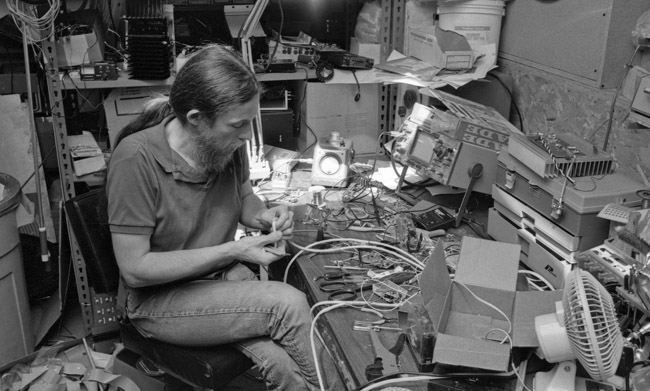
The creator of Free Radio Berkeley, Stephen Dunifer, was an activist who began broadcasting as a direct response to the media coverage of the Gulf War, as the airwaves were controlled by those who held the same interests as the government. At the time, the process to apply for a radio broadcasting license was complex and expensive. It involved engineering studies and petitioning of the FCC by communication law specialists. This expense, combined with the requirement that a radio station have a minimum broadcasting power of 100 watts, brought the total licensing costs to around $100,000, far beyond the reach of the vast majority of the population. The Committee for Democratic Communication contended that this was unconstitutional because the regulations were arbitrary and denied equal access to the spectrum.
Louis Hiken, a lawyer for radio pirates said,
"When the law says you have to regulate radio stations in the public interest and you create a regulatory scheme that says nobody but the very rich has access to the airwaves, that's unlawful."
Throughout the 1990s, there was a landmark legal battle between Stephen Dunifer and the FCC. Because of this, and the sheer volume of 1990s pirate radio activity, the FCC was eventually forced to alter its regulations. In 2000, the FCC officially created Low-Power FM (LPFM) licenses, legally allowing many community groups to broadcast at low wattages. This effectively ended the 1990s pirate radio boom by bringing many of those independent broadcasters onto legal, regulated airwaves.
Pirate radio today
There are far less pirate stations today because of the internet, but they are still out there. In the US, pirate broadcasters in larger cities tend to cluster on open frequencies near the bottom of the FM band (87.9 MHz to 91.9 MHz). And in less dense areas that need a longer reach, broadcasting on the SW band is popular. Stations frequently pop up on weekends and evenings, commonly broadcasting between 6,800 kHz and 7,000 kHz, with 6,925 kHz and 6,950 kHz (typically in Upper Sideband) being the most popular frequencies. They can also sometimes be heard on AM frequencies between 1,610 kHz and 1,720 kHz. So keep an ear on the airwaves, you never know what you’ll find.