"they try to make you think that it's all normal, all boring. but it isn't.
it's magic. it's all magic. everything is magic."
- tank girl
Radio waves are naturally occurring and part of the electromagnetic spectrum, just like light. They existed long before we figured out how to transmit voice and music with them. They have the lowest frequencies, lowest energies, and longest wavelengths in the electromagnetic spectrum. Because radio waves have such long wavelengths, they can easily pass through the Earth's atmosphere, foliage, and many building materials without getting blocked. They are also emitted naturally by celestial bodies like stars and pulsars, which is why astronomists can use radio waves to study space.
Also, radio waves travel at the same speed of light, and, in the vacuum of space, if nothing gets in the way to stop them, they can travel forever. There is a possibility that radio broadcasts from decades ago are still travelling through space. Unfortunately, the farther they travel, the weaker their signal becomes, and eventually the signal becomes so weak that it is lost in the ambient radiation of the universe. (but they’re still out there)
So how do radios work?
Step 1. Transduction (converting sound to electrical signal)
Sound waves (vibrations in air pressure) hit a microphone. The microphone then converts these vibrations into an alternating electrical current.
Step 2. Modulation
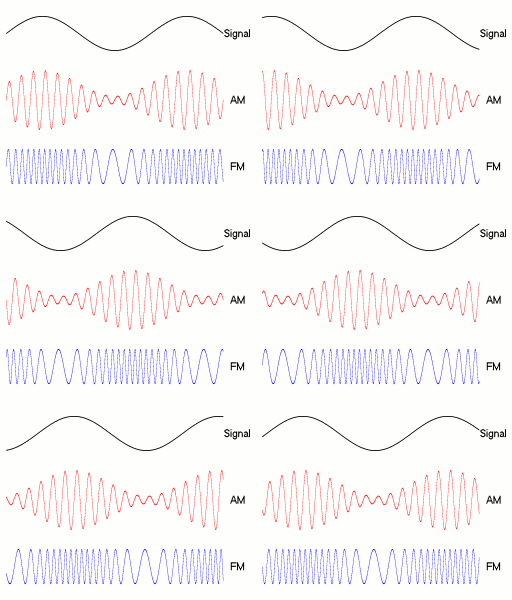
Because these audio electrical signals are very weak and cannot travel far on their own, a radio transmitter generates a high-frequency carrier wave. The audio signal is combined with the carrier wave by altering its pattern in one of two ways:
- Amplitude Modulation (AM), which alters the height (amplitude) of the carrier wave to match the strength of the audio signal, while its frequency remains constant.
- Frequency Modulation (FM), which alters the speed (frequency) of the wave, while the amplitude remains the same.
- A secret third option is continuous wave (CW) which does not modulate the wave at all and is only able to be used for sending morse code.
Step 3. Transmission
The modulated wave is sent to the transmitting antenna. The antenna’s alternating electrical current causes electrons to oscillate back and forth, emitting electromagnetic radio waves. These radio waves push outwards, traveling through the air or space at the speed of light.
Step 4. Reception and Demodulation
When the radio waves hit your receiver's antenna, they create a weak electrical current. Your radio tuner isolates the specific frequency it wants (the one it’s tuned to) and strips away the carrier wave (a process called demodulation) to leave only the original audio electrical signal. Finally, this electrical audio signal is sent to the radio’s speaker. The speaker's cone vibrates back and forth, pushing against the surrounding air and creating the sound waves that reach your ears.
The tl;dr version of this is, basically, you speak into a transmitter, the transmitter wiggles some waves to match your sound waves, the antenna pushes the waves out, then a radio receives it and changes the radio wave back into a sound wave.